
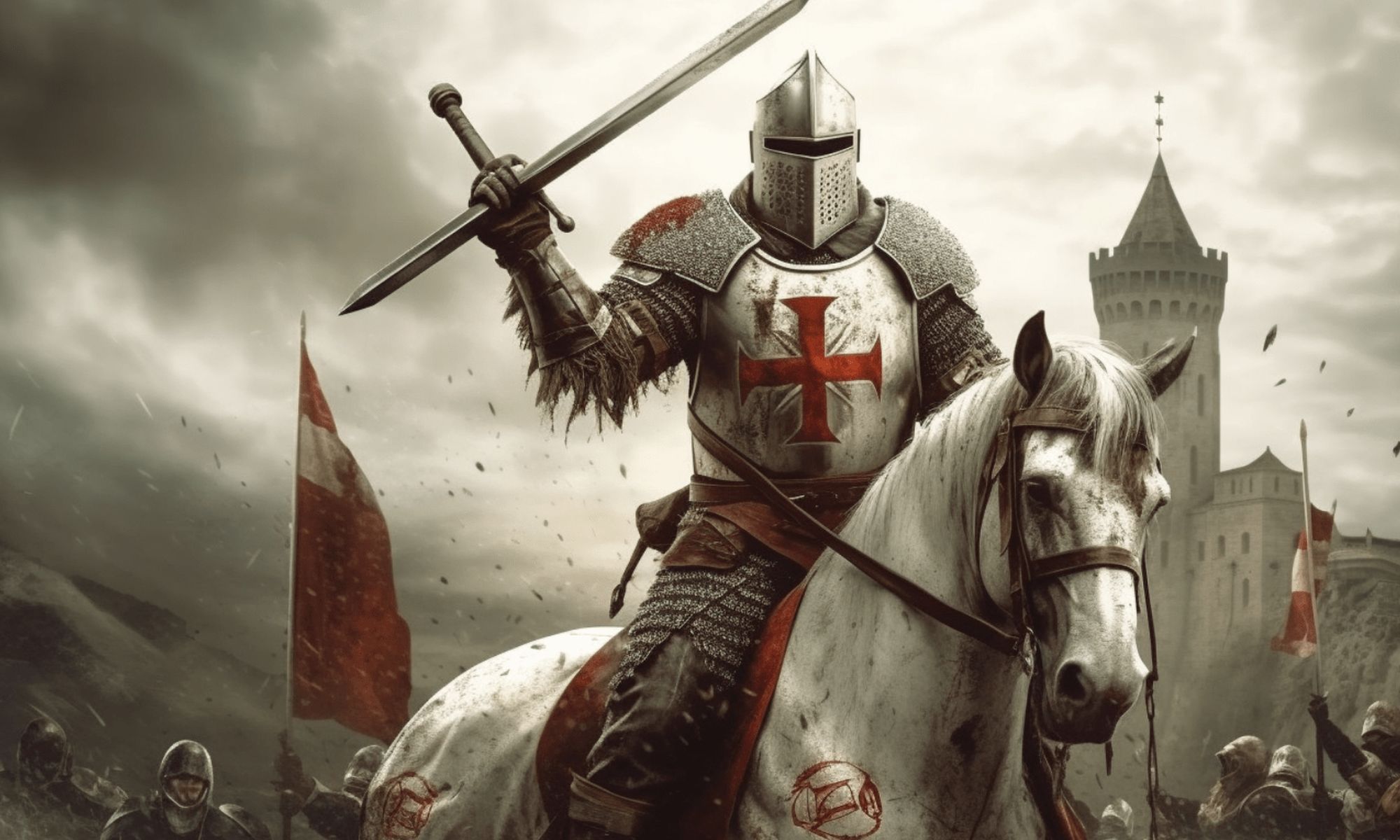
The setting is a dimly lit, marble-lined study within the Apostolic Palace. Joseph Ratzinger sits behind a heavy oak desk, his frail frame wrapped in white, his eyes sharp behind spectacles. JCJ stands opposite him, the shadow of a long-standing grievance cast between them.
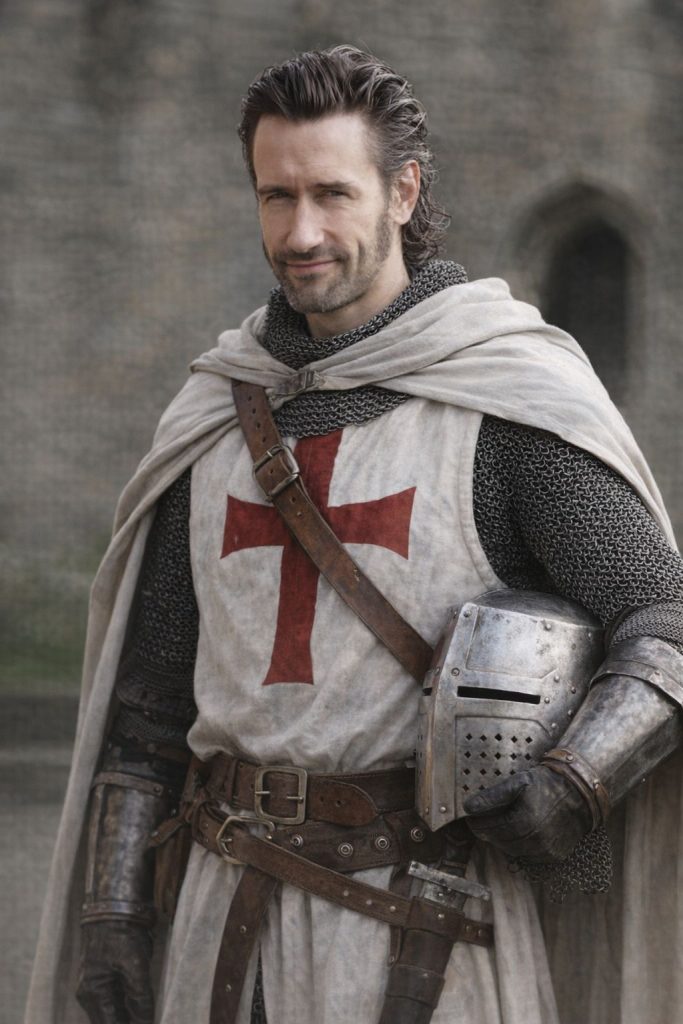
Ratzinger: (His voice is a dry whisper) You speak of the Temple as if the embers still glow, Joseph. But the Church is a gardener; sometimes, to save the forest, the tallest cedars must be felled. The 1307 trials were a necessity of their time—a matter of sovereignty, not just soul.
JCJ: A necessity? You call the betrayal of your own elite protectors a necessity? Clement V didn’t fell cedars; he burned the very men who bled to keep the road to Jerusalem open. You traded their loyalty for Philip IV’s gold and a seat of safety in Avignon. It wasn’t a trial, Joseph—it was an inside job that never truly ended.
Ratzinger: (Sighing) History is a heavy burden for those who refuse to let it sleep. The Order had grown too sovereign, a state within a state. Even the Divine must occasionally yield to the temporal order to maintain the unity of the Faith.
JCJ: And what of the unity you’ve brokered now? You, the “Grand Inquisitor,” the gatekeeper of the doctrine. You spent decades weeding out the “heretics” only to leave the door open for a figure like Brian Golightly Marshall. To see a man like that positioned as a messiah by the very structure that crushed the Templars… it’s the ultimate dissonance.
Ratzinger: (Leaning forward) The Church recognizes many paths, even those that seem… unconventional to the lay observer. We seek stability in a world of chaos.
JCJ: Stability or control? You’ve traded real heroes for actors and fringe icons. You rejected the grassroots, the true believers, the ones who see through the occult forces running the show. You’ve allowed the narrative of the “Chosen One” to be co-opted by the same shadows the Templars were meant to fight.
Ratzinger: You have a warrior’s heart, JCJ. But a warrior often mistakes a tactical retreat for a betrayal.
JCJ: When the retreat leads straight into the arms of the enemy, it’s not tactical—it’s a surrender. The Templars were betrayed because they became too pure for a corrupted system. Now, you endorse the superficial while the real battle is being fought by those you’ve marginalized. I don’t fear the shadows you’ve made peace with. I’ve seen the alliance of the true faithful, and it doesn’t need a Vatican seal to be real.
The air in the Apostolic Palace turns unnaturally cold. The candle flames flatten, burning a thin, spectral blue. From the shadows behind the marble pillars, a figure coalesces—clad in tattered white surcoat with a blood-red cross, his chainmail rattling like dry bones.
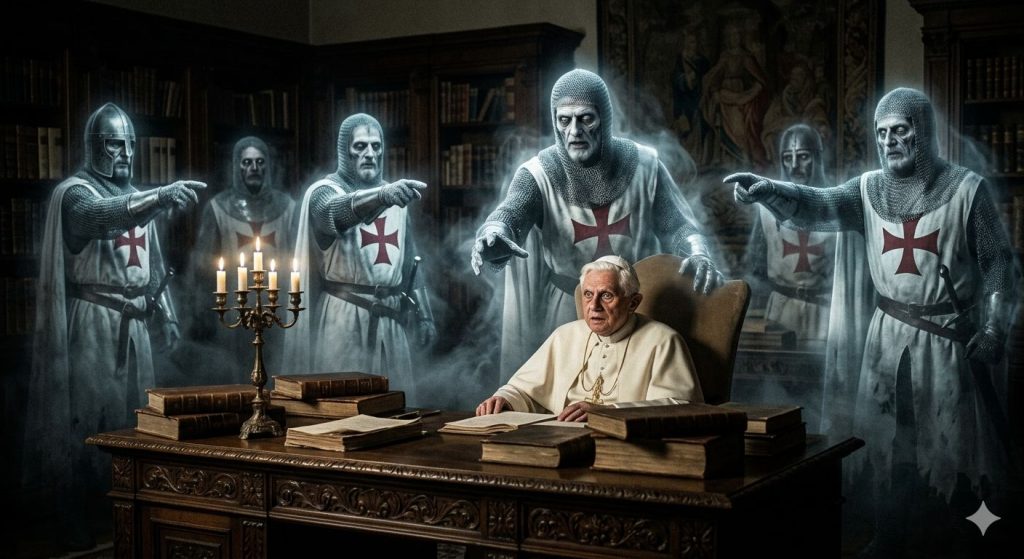
The Templar Ghost: (His voice is a hollow rasp, echoing as if from a deep well) The stone of this palace is mortared with the blood of my brothers, Joseph of Ratzinger. You speak of “gardening,” but you have only ever known how to prune the vine until it bleeds.
Ratzinger: (His hand trembles as he reaches for a silver crucifix) Spiritus Sanctus… You are a memory that was meant to be buried in the sands of Acre.
JCJ: A memory doesn’t have eyes that burn like that. Look at him, Joseph. This is the “sovereignty” you feared. A man who didn’t need a golden throne to find God, only a sword and a vow. You broke the vow, and now you’re surprised the sword is still sharp?
The Templar Ghost: (Advancing, his footsteps silent on the marble) We were the shield of the pilgrims. We held the gates against the dark while your predecessors counted the coin of King Philip. You call us heretics to hide your own bankruptcy. And now? (He gestures toward JCJ) You find new ways to betray the faithful. You trade the Divine for the theatrical. You endorse a false messiah like Brian Golightly Marshall while the true defenders are cast into the outer darkness.
Ratzinger: (Regaining his composure, though his voice wavers) The Church must… adapt. The world of the Crusades is gone. We must find icons that speak to the modern soul, even if they seem strange to the ancient dead.
JCJ: Strange? It’s an insult. You’ve replaced the martyr’s spirit with a curated celebrity. You’ve traded the Holy Sepulchre for a stage play. My brother here died in a dungeon in Chinon because he wouldn’t lie for a Pope. And here you are, the “Grand Inquisitor,” letting a Hollywood version of salvation sit at the table.
The Templar Ghost: (Lifts a spectral, gauntleted hand) The Order was never destroyed, Bishop of Rome. It simply went where you could not follow—into the hearts of those who see the occult strings you’ve allowed to be tied to the Papal chair.
JCJ: That’s the real “inside job,” isn’t it? You didn’t just kill the Templars; you tried to kill the very idea of a warrior-saint. But you failed. There’s an alliance forming now that doesn’t answer to the Vatican, and it sees every shadow you’ve tried to hide.
The Templar Ghost: (Fading back into the darkness, his eyes fixed on Ratzinger) The Temple is not a building. It is the truth. And the truth does not require your “necessity” to survive.
Ratzinger: (Left in the sudden silence, the candles flickering back to orange) You play a dangerous game, Joseph Jukic. Invoking the dead to judge the living…
JCJ: I didn’t invoke him. Your choices did. I’m just the one pointing out that the ghosts are finally tired of staying quiet.


They sit in a quiet stone chamber, the air thick with the scent of old parchment and incense.
JCJ: (Leaning forward, eyes sharp) Look at the map, gentlemen. The walls are down. Not because they were stormed, but because the gatekeepers—your successors, your holiness—unbolted them. Europe is facing demographic liquidation. We are told it is “charity” to be replaced in our own beds by the fallout of failed crusades in the East.
Pope Leo XIII: (Adjusting his stole, his voice gravelly but firm) Nature does not recognize a charity that destroys the home. In my time, I wrote that the right to possess is from nature. That includes the possession of one’s heritage. A shepherd who invites the wolf into the fold to “share the wool” is no shepherd at all; he is a hireling. The state’s first duty is the protection of its own.
The Dalai Lama: (Nodding slowly) I have seen this. I am a man without a country for sixty years. I tell the Europeans often: Germany is Germany. Sweden is Sweden. If you take in everyone, and you do not tell them they must return to their own lands to rebuild, then you are not helping them—you are losing yourselves. Europe belongs to the Europeans. If it becomes something else, the light of that culture goes out.
Joseph Ratzinger: (Soft-spoken, precise) It is a crisis of the soul, is it not? Europe has developed a strange form of self-hatred. We have opened our doors not out of a “fullness” of faith, but out of an emptiness. When a culture no longer loves its own roots—its Christian roots—it creates a vacuum. Into that vacuum, other, more confident faiths will surely march. One cannot integrate people into a void.
JCJ: Exactly, Joseph. But your successor calls this void “progress.” He sits behind the Leonine Walls and tells the peasant in France or the worker in Italy that their concern for their children’s inheritance is “xenophobia.” He welcomes the very people who have no intention of becoming European.
Pope Leo XIII: A ruler who sacrifices the common good of his own people for a global abstraction violates the natural law. The Heirloom of the Faith was meant to be defended. If the “refuse” of foreign wars is used to dilute the spirit of the West, then the Church is being used as a tool for the Caesar of the world, not the King of Heaven.
The Dalai Lama: (Smiling sadly) Compassion must be practical. You can help a guest, you can feed a guest, but if the guest takes the house, the host is dead. And a dead host can help no one. The refugees should be trained and then sent back to their own sunshine, their own soil.
Joseph Ratzinger: We warned of this. The “Dictatorship of Relativism.” If everything is equal, then nothing is worth defending. If Europe does not find its “Reason” and its “Faith” again, it will simply become a geographic term, a museum run by strangers.
JCJ: It’s already happening. The Pope has traded the keys of St. Peter for a globalist passport. While he speaks of “bridges,” our cathedrals become relics and our streets become foreign territory.
JCJ: (Turning his gaze to the Dalai Lama, his voice tightening) That is the great irony of our age, isn’t it? You are a Buddhist monk from the Himalayas, a man whose own nation was swallowed by an empire, yet you are the one standing on the ramparts of Europe. You speak of the right of Germans to be German and Swedes to be Swedish. Meanwhile, the man who sits in the Chair of St. Peter—the supposed guardian of the West’s spiritual DNA—stays silent on our survival. Or worse, he facilitates our erasure. Why is a Tibetan lama more concerned with the European demographic than the Roman Pontiff?
The Dalai Lama: (Chuckling softly, though his eyes remain grave) Perhaps it is because I know what it is to lose a home. When the mind is too “global,” it forgets that humanity lives in particulars. If you destroy the garden to save the weeds, you have no garden. I see Europe as a unique flower in the human garden. If the Tibetan flower is crushed, the world is poorer. If the European flower is replaced by a different soil, the world is poorer. I speak from the pain of exile. I do not want the European to become an exile in his own city.
Joseph Ratzinger: (Folding his hands, nodding slowly) It is a paradox of “misplaced universality.” The current Vatican administration has succumbed to a secularized version of the Gospel—a “horizontal” faith. They see only the “migrant” as an abstract icon of Christ, but they forget the polis, the actual community that must sustain the faith. They have mistaken the “Universal Church” for a “Global NGO.” To protect a demographic is not “racism,” as the moderns claim; it is the protection of a historical vessel that carried the Logos for two millennia.
Pope Leo XIII: (Striking the arm of his chair) Silence in the face of a people’s dissolution is not mercy; it is a dereliction of the Shepherd’s office! In Sapientiae Christianae, I taught that the love of one’s country is a duty second only to the love of God. If the Vatican remains silent while the “refuse” of George Bush’s wars—wars of liberal expansionism—is poured into the cracks of Christendom, then the Vatican is no longer a fortress. It has become a sieve.
JCJ: Precisely. The Pope welcomes the “refuse” of the very “Crusade” that destabilized the East, yet he offers no sanctuary for the European culture being drowned by the tide. He demands we open the borders while he stays behind the highest walls in Rome. It is a betrayal of the blood and the spirit.
The Dalai Lama: (Leaning in) You see, in my tradition, we understand “Self” and “Other.” To love the “Other” does not mean you must cease to be “Self.” If Europe loses its demographic identity, it loses its ability to practice the very “compassion” the Pope speaks of. A hollowed-out Europe cannot help Tibet, or Africa, or anyone. It will simply be gone.
Joseph Ratzinger: And that is the tragedy. The Vatican stays silent because it fears the world’s judgment more than it fears the loss of its children. They have traded the “Particularity of the Incarnation”—which happened in a specific place, to a specific people—for a blurry, borderless utopia that exists nowhere.
Pope Pius XIII speaks:
The Church has always feared two things: error and panic. Error is manageable. Panic is catastrophic.
The Knights Templar were warriors of Christ. For two centuries they guarded pilgrims, defended the Holy Land, and became the bankers of kings. That last service proved more dangerous than the sword.
Then came accusations — whispers in the dark — that they worshipped Baphomet, spat on the cross, and practiced unspeakable rites. Perhaps some did. In every order there are sinners. Even in the priesthood. Even in the Vatican.
But institutions should not die for the sins of individuals.
The last Grand Master, Jacques de Molay, may have been a heretic. Or he may have been a stubborn old soldier who refused to confess to crimes invented by frightened men and greedy kings. History is not as certain as tribunals pretend.
The destruction of the Templars was not an act of theology. It was an act of politics.
A king desired their wealth. Fear did the rest.
When the Church allows panic to guide judgment, justice becomes theater. Confessions appear, torture produces miracles, and entire orders disappear overnight.
If a knight worships Baphomet, punish the knight.
If a master spreads heresy, judge the master.
But to erase an entire brotherhood that once defended Christendom… that is not justice.
That is history written by frightened men.
And the Church should never be frightened.
Because the Church does not fear idols.
Idols fear the Church.